

 Reading | 5 min
The New Generation of Integrity: How Ukrainian Youth Drive Anti-Corruption Change
 |
Written by Karolina ShmalkoDeputy Chairman of EDYN Ukraine
|
Over the past decade, Ukraine has been undergoing a difficult yet crucial path of transformation. One of the key driving forces behind these changes has been youth — activists, elected representatives at various levels, public servants, researchers, and members of civil society who consistently promote the principles of transparency, accountability, and integrity.
For the new generation of Ukrainians, the fight against corruption is not merely a political slogan but a necessary condition for the country’s development, strengthening trust in institutions, and advancing Ukraine’s European integration.
“For the new generation of Ukrainians, the fight against corruption is not merely a political slogan but a necessary condition for the country’s development.”
A Generation Shaped After the Revolution of Dignity
For many young Ukrainians, civic engagement did not begin in university classrooms or within civil society organizations, but on the streets of Kyiv during the Revolution of Dignity in 2013–2014. These events became a turning point in Ukraine’s modern history and helped shape a new generation of citizens for whom democratic values, government transparency, and the fight against corruption became key public demands.
Euromaidan began on November 21, 2013, after the government announced it would suspend preparations for signing the EU Association Agreement. The first protests gathered activists and journalists at Independence Square in Kyiv, later transforming into the Revolution of Dignity following the attempted violent dispersal of demonstrators on the night of November 30–December 1.
According to various estimates, millions of citizens across the country participated in the events of the Revolution of Dignity over the course of three months, including in Kyiv, Lviv, Uzhhorod, Kharkiv, Donetsk, Zaporizhzhia, Kherson, Dnipro, and many other cities. During the largest rallies in December 2013, between 500,000 and more than one million people gathered simultaneously at Independence Square in Kyiv.
The protests aimed not only to support the country’s European course but also to defend Ukrainian statehood and civic identity.
After the protests ended following the brutal shootings of peaceful demonstrators on February 18–20, during which more than 100 people were killed, some activists continued defending the values that had crystallized during the Revolution of Dignity with weapons in their hands.
Just four days later, on February 24, Russian military forces were spotted on the Crimean Peninsula, and in April they moved to active operations in eastern Ukraine. This marked the beginning of the Russian-Ukrainian war.
Another part of the activists returned to civilian life and began working to create new institutions and civil society organizations. It was after the Maidan that a large-scale anti-corruption reform process began in Ukraine.
A key starting point was the adoption of the Law on Prevention of Corruption in October 2014, which launched the creation of the country’s anti-corruption infrastructure. By 2015, key anti-corruption institutions had begun operating, including the National Anti-Corruption Bureau of Ukraine (NABU), the National Agency on Corruption Prevention (NACP), and the Specialized Anti-Corruption Prosecutor’s Office (SAPO).
At the same time, an ecosystem of civil society organizations and movements began actively developing, taking on the role of public oversight of reforms.
A new generation of young lawyers, analysts, journalists, and civic activists continues to contribute to these reforms today. For example, the Anti-Corruption Action Center became one of the key advocates for anti-corruption reforms and the establishment of independent institutions. The DEJURE Foundation focused on judicial reform and monitoring the integrity of judges, while the investigative journalism team Bihus.Info exposes corruption schemes in politics and the public sector.
The Reanimation Package of Reforms Coalition, established in 2014, united dozens of organizations to promote systemic reforms in areas such as anti-corruption policy, the judiciary, decentralization, electoral legislation, energy, and public governance. Today the coalition includes 30 civil society organizations.
It was during this period that a new generation of experts, lawyers, journalists, and civic activists emerged to work in the field of reforms. For many of them, civic activism that began during the Maidan became their professional career.
Importantly, the Revolution of Dignity also shaped a culture of civic responsibility among young people. Ukrainian youth today participate much more actively in civic initiatives, political processes, and civil society activities compared to previous generations.
Corruption as a Societal Challenge
According to research conducted on behalf of the National Agency on Corruption Prevention, 91.4% of Ukrainians consider corruption a widespread problem, although only 18.7% reported having personal experience encountering corruption.
International studies also confirm that fighting corruption remains one of the key reform priorities. According to the Corruption Perceptions Index published annually by Transparency International, Ukraine scored 36 out of 100 in 2025, indicating gradual but still challenging progress in reforms. For comparison, Ukraine scored only 25 points in 2013, demonstrating steady progress in the fight against corruption over the past decade.
Separate studies show that young people demonstrate particularly high levels of intolerance toward corrupt practices. For example, according to research on the values of young Ukrainians, nearly 90% of young respondents stated that corruption should not be tolerated, reflecting a strong normative stance among the new generation regarding integrity in Ukrainian society.
Importantly, an anti-corruption culture is shaped not only through civic engagement but also through education. Specialized educational programs aimed at training experts in corruption prevention and anti-corruption policy have emerged in Ukraine.
For instance, the National University of Kyiv-Mohyla Academy hosts a master’s program titled “Anti-Corruption Studies,” created by the Anti-Corruption Research and Education Centre (ACREC). It is the first interdisciplinary program in Ukraine that prepares analysts, investigative journalists, lawyers, and anti-corruption policy specialists.
At the same time, the National Agency on Corruption Prevention actively promotes a culture of integrity and anti-corruption in schools and higher education institutions through educational initiatives, training programs, and integrity-focused campaigns.
Thus, the fight against corruption in Ukraine is increasingly shifting from reacting to individual violations toward the systematic formation of a new culture of integrity — a process in which youth play one of the key roles.
The 2025 Protests: Youth as a Driver of Public Oversight
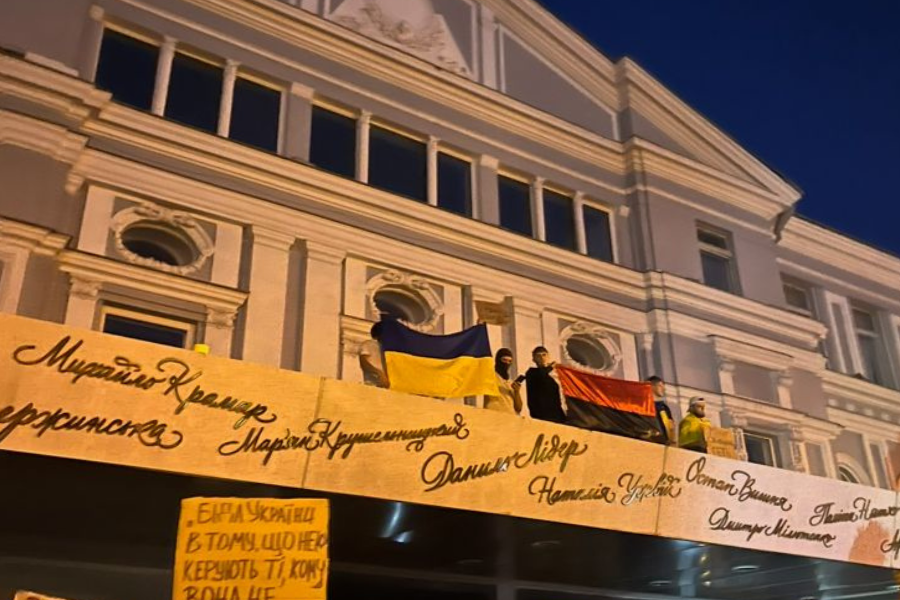
In the summer of 2025, Ukraine witnessed a response from the proactive part of society to an attempt to undermine the independence of anti-corruption institutions. Peaceful protests took place in various cities across the country, with youth making up a significant share of participants.
According to estimates by media outlets and organizers, between 10,000 and 16,000 people participated in the protests in Kyiv alone, making them the largest peaceful demonstrations since the Revolution of Dignity in 2013.
The protests were triggered by the parliament’s adoption of a bill that effectively undermined ten years of work by the state and civil society. Most of the powers of the National Anti-Corruption Bureau of Ukraine and the Specialized Anti-Corruption Prosecutor’s Office would become dependent on the Prosecutor General.
Civil society organizations and international partners viewed this as a potential weakening of the independence of the anti-corruption system.
A distinctive feature of these protests was that they were driven primarily by young people — students, young activists, and representatives of civil society. Participants came to the rallies holding simple cardboard signs, which is why the events began to be referred to in the media and on social networks as the “Cardboard Maidan.”
The movement became a symbol of peaceful protests against corruption and threats to democratic institutions. Many such rallies also took place in regional cities, demonstrating that youth can quickly mobilize to defend democratic principles and government accountability.
Young people became an important element of public oversight, reminding society that the independence of anti-corruption institutions is a foundation of a democratic state.
Investing in a Democratic Future
The experience of recent years shows that the younger generation is becoming the driving force behind democratic change in Ukraine. Young leaders actively promote European integration, anti-corruption reforms, and the development of civil society, shaping a new political culture of openness, accountability, and integrity.
Today, young people are not only demanding change but also directly participating in its implementation — working in civil society organizations, think tanks, media outlets, and public institutions.
Investing in youth leadership, education, and civic participation today is an essential prerequisite for building a transparent, democratic, and European Ukraine.