Reading | 4 min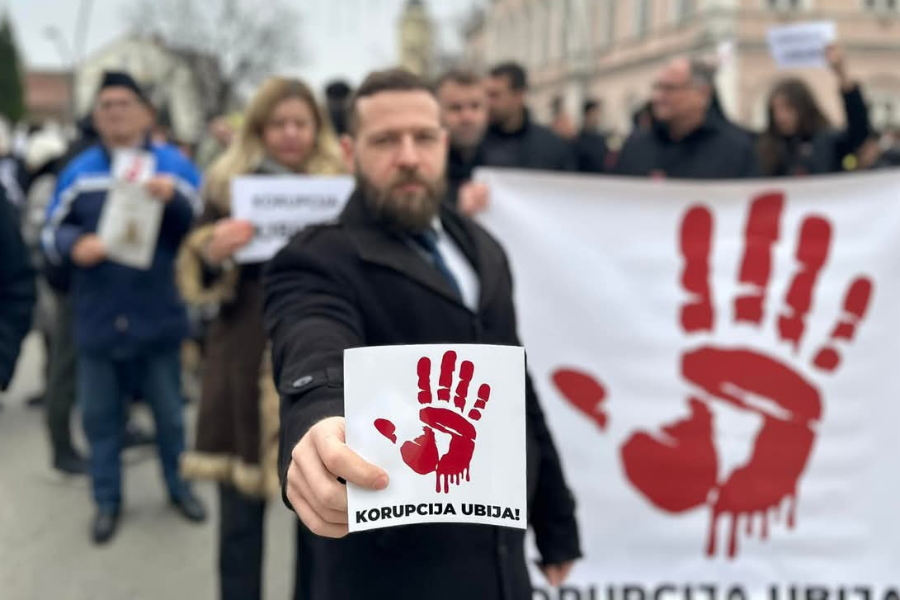



When people speak about the “last dictatorship in Europe,” they most often refer to Belarus, where freedom of thought and political choice has been practically abolished, journalists have been arrested or forced into exile, and—unfortunately—many members of EDYN are also fighting for their country from abroad. Recently, however, Serbia has increasingly begun to resemble Belarus, while Serbia’s Security Information Agency (BIA) is reminiscent of the infamous KGB.
On November 1, 2024, the canopy at the railway station in Novi Sad collapsed, killing 16 people. The government’s first reaction was to lie, claiming that this particular part of the building had not been included in the recent reconstruction project, which officially cost €16 million. This claim was quickly exposed as false. It soon emerged that the largest portion of the money—around €12.5 million—had ended up in the hands of tycoons close to the ruling party, and that 16 lives were lost due to corruption and criminal negligence. Since then, citizens and students have taken to the streets across Serbia.
During the preparations for the protest on March 15 last year, the Security Information Agency illegally wiretapped a conversation between 12 activists who were, among other things, discussing the logistics of the protest. Parts of this conversation were deliberately cut out of context and broadcast by all pro-government media outlets (which, in practice, includes almost all media except two cable television channels). These edited recordings were presented as evidence of plans for a terrorist attack and an attempt to overthrow the constitutional order of the Republic of Serbia. Following this, six activists were arrested, while the other six happened to be outside the country at the time and have remained abroad ever since.
The arrested activists spent seven months in pre-trial detention, even though one of the detained students had not even been present at the disputed meeting. The activists who were outside the country remain in exile, as they face political persecution if they return to Serbia. To be clear, nothing they did constitutes a criminal offense, yet the authorities accuse them of terrorism because doing so serves the interests of the ruling party and President Aleksandar Vučić.
Last August, the criminal regime of the ruling party ordered the police to break up a peaceful protest in the city of Valjevo. The police used tear gas against the gathered citizens and then beat anyone they could reach. People were pulled out of taxis and beaten; officers entered cafés and restaurants and brutally assaulted anyone they could get their hands on. After this orgy of police violence and brutality, the Minister of the Interior stated that the police had acted within their legal authority and had merely defended themselves, despite the abundance of videos that flooded social media, clearly showing up to fifteen police officers beating a single person until they collapsed, then kicking them and stomping on their head with boots. The victims were ordinary citizens, students, a volunteer from the first aid service, and even a minor who happened to be there by chance.
At the beginning of this year, Serbian farmers began protesting government policies that threaten their livelihoods. Since the ruling regime does not support domestic food production and instead benefits from companies linked to it importing food, the authorities responded with police repression. In the small town of Badovinci, the police were ordered to disperse a peaceful protest. In addition to breaking up the protest, they arrested five farmers with the intention of placing them in detention, not because they had committed any criminal offense or because there were legal grounds for detention, but to intimidate other farmers and discourage further protests.
Initially, two of the detained farmers were placed in custody by a judge who delivered a political speech repeating the standard narrative used by the regime (“political activists paid to destroy the state,” and similar claims). Fortunately, following an appeal, the detention of both farmers was eventually overturned, but criminal proceedings are still ongoing against all five.
Once again, the ruling party used state institutions as tools to suppress the growing dissatisfaction among citizens. And the author of this text has information that his phone is being illegally wiretapped by the security services when he defends political prisoners and when protests are organized for their freedom.
Just a few days ago, the police in Belgrade detained four students who were carrying donations collected from free citizens of Serbia—around €17,000—and confiscated the money. The students were released because there was no legal basis for any form of detention, but the police kept the money. The students, therefore, justifiably believe that they were robbed by the regime’s police. However, an even more important question remains: how did the police know which students would be carrying the money and at what time? The only plausible answer is that the Security Information Agency is illegally wiretapping students.
Totalitarianism is returning—not only in Serbia but in other European countries as well—and it is up to us to fight for our rights and our freedom.
“Democracy has to be born anew every generation.” — John Dewey