Reading | 3 min
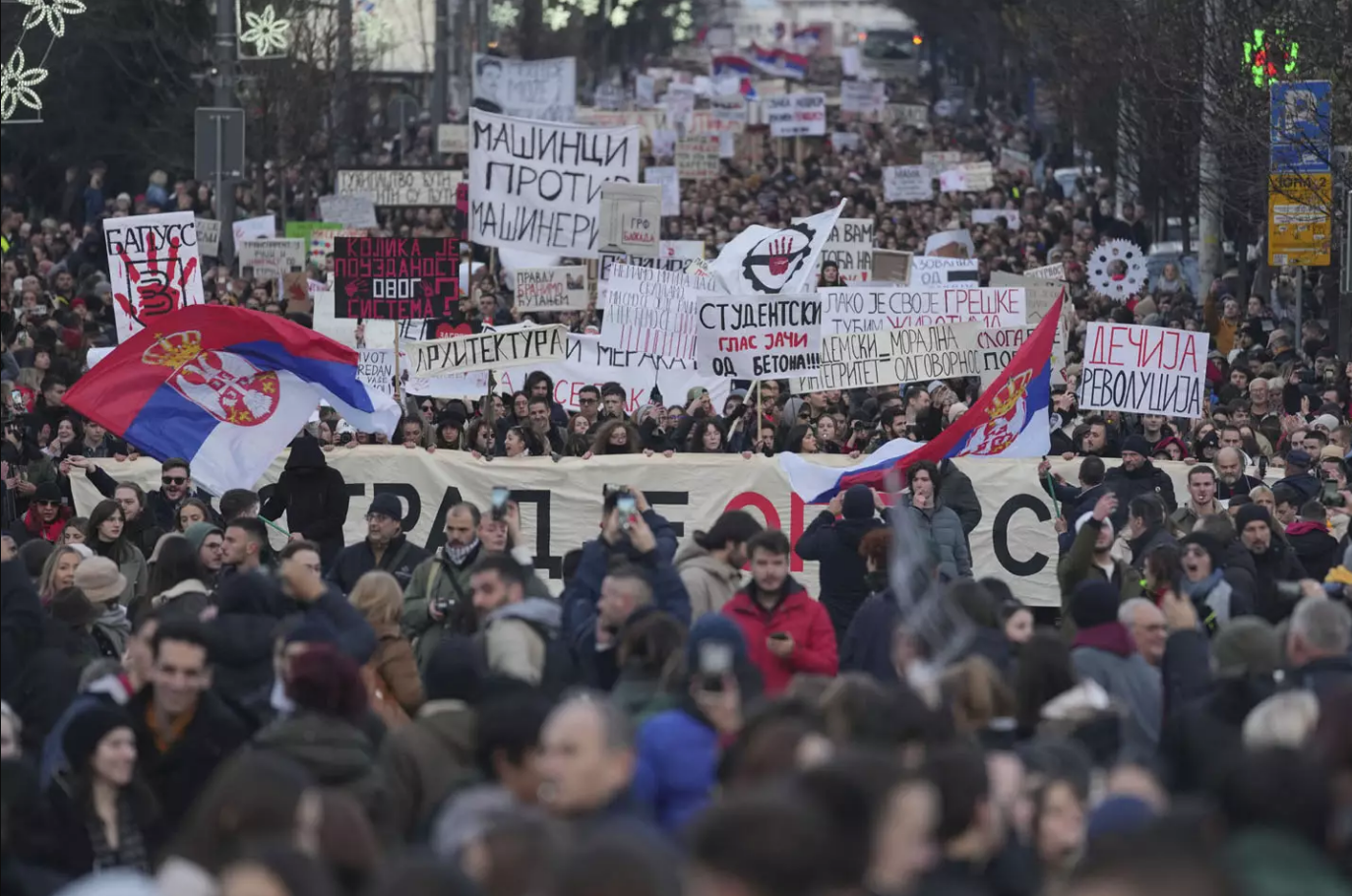


For fourteen years, Aleksandar Vučić turned Serbia into his personal fiefdom. He gradually took control of state institutions, shut down independent media and undermined democracy, while turning elections into a farce in which political parties compete, only for him to win regardless of the level of public support. This autocrat was eventually brought down by students.
Or, to be more precise, it all began after the collapse of the canopy at the railway station in Novi Sad, which claimed 16 lives. The sole survivor lost both legs and underwent bilateral amputation. All citizens were asking for was justice and accountability.
Among those who lost their lives were two little girls, aged nine and seven, and their grandfather; a young couple, aged 21 and 20, who were on their way to tell their friends and parents that they were expecting a baby (they were found embracing beneath several tonnes of concrete); a distinguished scientist from North Macedonia; two high school students, aged 16 and 17, returning home from school; a 23-year-old university student travelling to her hometown; and others who happened to be at the station on that tragic day.
Instead of justice, we got Aleksandar Vučić’s lies and claims that nobody was to blame. Instead of accountability, we witnessed thugs attacking students and citizens who were standing peacefully and paying their respects to the victims. The police were entirely under his control, while the courts and prosecutors were prevented from doing their jobs. Other state institutions actively worked to conceal those responsible for the tragedy, as well as those behind the violence against citizens.
Vučić deliberately fuelled hatred and division, urging his supporters to run over protesting citizens with their cars. He labelled students as terrorists and Ustaše, accusing them of exploiting the tragedy to seize power and enrich themselves. Several times a day, he appeared live on national television channels, accusing students of destroying the country and orchestrating a so-called colour revolution. Meanwhile, certain cable television channels had become nothing more than factories of lies and propaganda.
Yet none of this was enough to silence the people.
In response to the capture of state institutions, repression against citizens and attempts to violently crush the protests, a nationwide uprising erupted in Serbia, led by students. Over the course of two years, students walked across the entire country, travelling from one end of Serbia to the other. In towns and villages, people welcomed them as liberators, offering them food and accommodation. Step by step, they carried the torch of freedom across the country.
It all culminated in late October, when parliamentary elections were held and Vučić suffered a crushing defeat. Despite spending millions on buying votes, purchasing so-called opposition parties, funding marketing campaigns, and employing thugs and criminal groups, he had no choice but to concede defeat. The arrests of some of his closest former associates began just days later, even before the electoral process had formally concluded and before the Student List had taken office.
However, we will not hide our disappointment with the European Union. For years, the overriding priority for bureaucrats in Brussels was what they called ‘stability in the region’. While Vučić was systematically dismantling democracy, he was being patted on the back and treated as a reliable partner. When students cycled all the way to Strasbourg and organised a relay run to Brussels, only a handful of Members of the European Parliament turned up to welcome them. Not a single senior EU representative was there.
We fought for European values – respect for human dignity, freedom, democracy, equality, the rule of law and human rights – on our own, without anyone’s help. Serbia has shown Europe what European values really mean and what it takes to stand up for them.
Today, Serbia is Europe.