
 Reading | 5 min
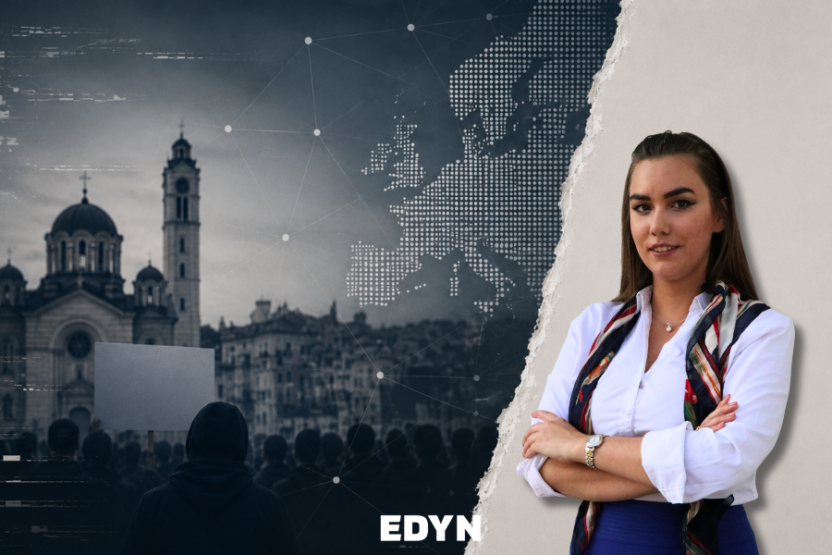
With the EDYN Presidential elections approaching, we’re continuing our series of interviews with the people ready to shape the network’s future. Each candidate offers their perspective on leadership, civic engagement, and their vision for EDYN in the years ahead.
This time, we introduce Aleksandar Mijailović — EDYN member from Serbia.
1. Who are you? Give us a short introduction.
My name is Aleksandar Mijailović, and I come from Šabac, Serbia. I graduated from the Faculty of Law at the University of Novi Sad. I am a member of the political party Zajedno (Together), where I serve as the head of its legal team. I am also a member of the EDYN Leadership Council and a co-founder of two youth organizations in Serbia.
My core interests revolve around the development and protection of democracy, electoral systems, and elections. I have gained substantial experience in these fields through my work in political parties and various democratic initiatives. In 2022, for example, I served as the Head of the Election Monitoring Team for the Moramo (We have to) coalition, and I was also a member of the Republic Electoral Commission of Serbia. In addition to these responsibilities, I am a strong advocate of direct democracy and deeper decentralization. I actively promote youth rights through numerous initiatives and activities created both for young people and by young people. To strengthen my work in this area, I completed the EDYN and NDI “Trainer of Trainers” program and obtained a professional training certificate.
Professionally, I work as an attorney. I founded my own law office in November 2020, and through my legal practice I have had the opportunity to represent and successfully defend politically persecuted students in Serbia, as well as opposition activists and party members. Alongside my role in the political party where I lead the legal team, I also provide legal support to a wide range of organizations and initiatives focused on the defence of democratic principles.
One of my greatest strengths is the way I approach goals and long-term visions. When I have a clear objective, I immediately turn to structured problem solving. I rely on methodical analysis, careful planning, and a practical understanding of how to turn ideas into concrete results. This combination of strategic thinking, legal expertise, and commitment to democratic values shapes my work both in the public sphere and in my professional legal career.
2. What inspired you to get involved in civic or public life, and to join EDYN?
At the age of 23, I realized I was not someone who could sit on the sidelines, comment from a distance, and never take concrete action. That realization pushed me to join a political party that governed my hometown at the time. My city was the only opposition-led city in Serbia, standing against the ruling government at the national level. When I saw that a community could grow and develop despite pressure from above, and even become one of the fastest-developing cities in the country, I understood that this was the political movement I wanted to belong to.
From the very beginning, I carried a clear idea of what I wanted Šabac to become: the best city to live in across Southeastern Europe. That vision has guided me from day one. I believe political parties, when functioning democratically, are the most effective instruments for shaping the future we want to build. Politics, at its core, is simply the shared agreement about how our community should be organized.
Another major motivation for my political and civic engagement has been the ruling party in Serbia, whose actions have consistently undermined democratic institutions and the freedom of elections. Because I speak publicly and without hesitation about the government’s abuses, I have personally been targeted by pro-government tabloids spreading false accusations about me. Despite this, I remain certain that Serbia will return to democratic governance, and that Šabac will again become a model city.
What attracted me to EDYN the most was its idea – to connect young leaders from countries with post-totalitarian backgrounds. I saw EDYN as a community of young people similar to myself: capable, motivated, and determined to build democratic systems in countries where genuine democracy has long been absent. It is also a space where young leaders confront challenges similar to those we face in Serbia. I believe this kind of cooperation is especially important today, at a time when democratic values are increasingly under threat from both the East and the West.
3. What made you decide to run for EDYN President? What is your vision for EDYN in the coming years?
After five years as a member of the network, two years in the Leadership Council, and meeting a large number of EDYN members across the continent, I believe I now have a deep understanding of the network and that I am in a unique position to contribute at the highest level to its further development.
EDYN has changed significantly over the past two years, but not enough. We need a strong and deliberate push as we enter a new chapter in the network’s growth. For me, this new phase rests on three core ideas. First, EDYN must focus on concrete and timely challenges. Given the pressures facing democracy in Europe today, I believe our priorities should be the protection of democratic values, safeguarding free elections, and countering populism and disinformation. These issues cut across all our countries, and EDYN is well positioned to address them.
Second, from a strategic standpoint, EDYN must generate clear and measurable value for its donors. This is essential if we want to pursue the goals we set for ourselves. As a network of more than 800 members in 23 countries, we have enormous potential, much of which can be activated even through small, cost-effective initiatives. With the right strategic direction, our size becomes an asset that can deliver meaningful impact.
Third, EDYN is ultimately a network of its members. We must do more to connect our members, support their initiatives, and create concrete opportunities for them. Without its members, EDYN does not exist, and increasing the value they receive from the network will be one of my highest priorities.
During my term, EDYN will become a recognizable and respected network in Europe, distinguished by a large number of implemented projects and by members who actively defend democracy and European values. By 2026, EDYN will have significantly more active and engaged members than it does today. This will be achieved through a clear presidential vision, support of the Leadership Council, and close coordination with HQ to deliver tangible actions on the ground.
4. What do you value most about the EDYN community and the people in it?
What I value most about the EDYN community is the commitment of its members. Even during the most difficult periods for the network, when there were not many opportunities available, many chose to remain active, contribute their time and energy, and continue working toward the vision we created together. That level of dedication speaks to the character of our members and to the strength of EDYN as a community.
I have had the honor and genuine pleasure of meeting dozens of EDYN members over the years. Many of them are highly accomplished in their fields, whether they are elected officials, journalists, students, activists, or politicians. From each of them I have learned something valuable, and many of them have helped me refine my own perspectives on the world. Being surrounded by people who challenge you intellectually and broaden your thinking is one of the most meaningful aspects of belonging to EDYN.
What I imagined EDYN to be when I first applied for membership turned out to be entirely true: a network of young people who are socially engaged, motivated, and deeply committed to building a better world. Every member I have met has a clear idea of the kind of society they want to live in, and that sense of purpose is not something one often encounters in the general population. Most of our members share the core values expressed in the Berlin Declaration, which all of us accepted. Even though this alignment cannot be taken for granted, it remains one of the foundations that keeps the network strong.
In the end, we can ask a simple question: would the world be better or worse if EDYN did not exist? The answer is equally simple: without EDYN, many young people would never have met, never exchanged ideas, and never shared their experiences in confronting the challenges we all face. At the same time, without the remarkable members we have today, EDYN itself would not be what it is. The value of this community comes from the people within it, and that is what I appreciate most.