
 Reading | 5 min
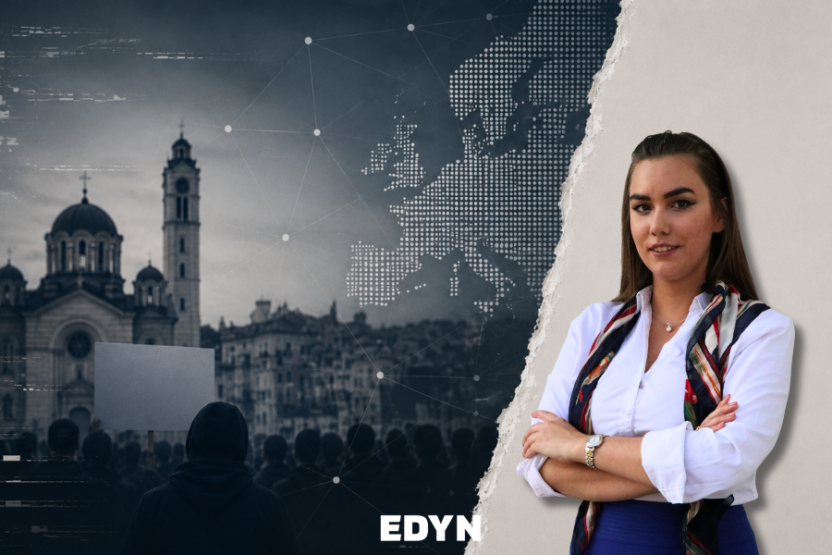
Rethinking Youth, Peace and Security in Europe
 |
Written by Gent SalihiMember of EDYN North Macedonia
|
Europe is often described as a space of stability, institutional maturity, and consolidated peace. Yet today’s security environment tells a more complex story. Armed conflict has returned to Europe’s soil, political polarisation is deepening, and public trust in democratic institutions is under strain.
In this context, peace can no longer be understood simply as the absence of war. It increasingly depends on social cohesion, credible institutions, and the inclusion of those who will live longest
with the consequences of today’s decisions. This is where the Youth, Peace and Security (YPS) agenda becomes relevant for Europe — not as a symbolic commitment, but as a practical framework for resilience and prevention.
The Gap Between Awareness and Influence
Young people across Europe are highly aware of the challenges shaping their security environment. They follow geopolitical developments, recognise the impact of disinformation and polarised
narratives, and experience firsthand the social and economic pressures that affect stability. Many engage through civil society, community initiatives, and digital spaces, often addressing issues
related to inclusion, dialogue, and conflict prevention.
Yet despite this engagement, youth participation in peace and security remains limited in scope and impact. Opportunities are frequently consultative rather than influential. Young people are invited to share perspectives, but rarely to create priorities, design responses, or assess outcomes. This creates a participation gap — not because young people lack interest, but because the pathways to meaningful influence are narrow and unclear.
This gap is particularly visible in security-related policymaking, which remains dominated by formal institutions and expert-driven processes. While expertise is essential, over-reliance on closed
frameworks risks overlooking early warning signals and social dynamics visible at community level, especially to younger generations.
Youth as Contributors to Peace, Not Just Beneficiaries
A recurring challenge in European discussions on peace and security is the tendency to frame youth primarily as beneficiaries of stability rather than contributors to it. This framing underestimates the role young people already play in strengthening resilience, countering polarisation, and sustaining dialogue across social divides.
For many young Europeans, peace is inseparable from trust in institutions, equal access to opportunities, and the ability to participate credibly in public life. When these elements are weakened, insecurity manifests not only through violence, but through disengagement, radicalisation, and declining confidence in democratic processes.
Recognising youth as peace actors does not mean lowering standards or bypassing institutional procedures. It means creating pathways for responsibility — spaces where young people can engage
consistently, understand constraints, and contribute to long-term solutions rather than one-off initiatives.
Making Youth Participation Credible
For the YPS agenda to be meaningful in Europe, participation must move beyond visibility toward credibility. This requires clarity about roles, expectations, and impact. Young people need to know where their input fits within decision-making processes and how it influences outcomes. Institutions, in turn, must be willing to listen, respond, and adapt.
Credible participation also depends on continuity. Short-term projects and isolated consultations may raise awareness, but they do little to build trust. Sustainable engagement requires institutional memory, feedback loops, and long-term commitment on both sides.
Importantly, youth participation should not be treated as a separate or parallel process. Peace and security are cross-cutting issues, and youth perspectives should be integrated across policy areas — from education and social inclusion to digital governance and democratic resilience.
A Shared Responsibility for Europe’s Future
Europe’s peace and security challenges are unlikely to be resolved through closed processes or generational silos. Sustainable peace depends on inclusive governance, social trust, and the ability to
respond early to emerging risks. The Youth, Peace and Security agenda offers a framework to strengthen these foundations — if it is applied seriously.
The question is no longer whether young people care about peace and security in Europe. Many already demonstrate that they do, through engagement that is often informal, local, and
overlooked. The real challenge lies in ensuring that this engagement is recognised, supported, and connected to decision-making processes.
Doing so is not an act of symbolism, but a practical investment in Europe’s resilience, democratic credibility, and long-term stability.