Reading | 5 min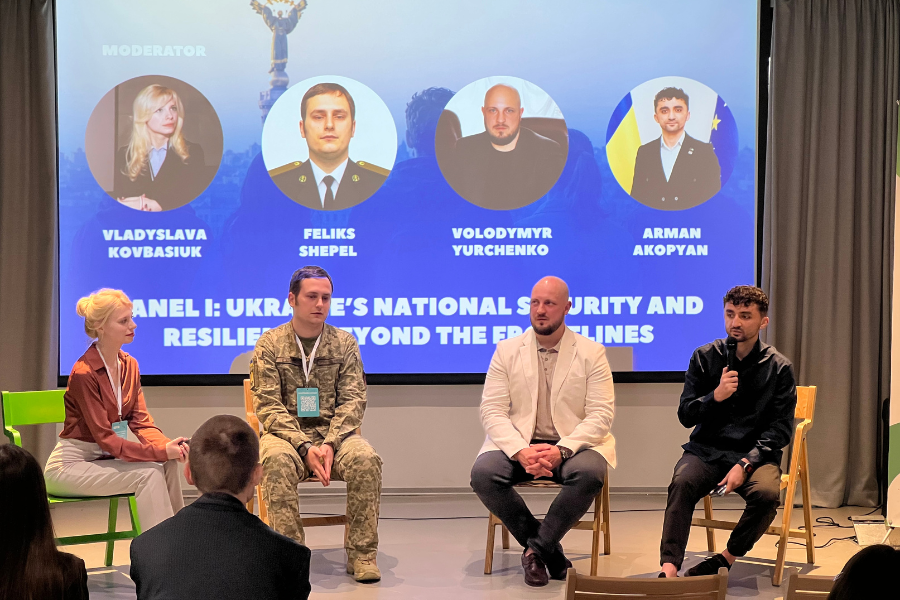


Russia’s full-scale invasion has fundamentally changed the way Ukrainians understand security. Today, security is not limited to military capabilities or events on the frontline. It also includes resilient communities, psychological well-being, technological innovation, democratic institutions, and meaningful youth participation in public life.
These topics were at the centre of the forum “Youth & Security Dialogue: The Role of Youth in Ukraine’s Defence and Resilience”, which took place in Kyiv on 14 June 2026.
The event brought together youth leaders, military personnel, civil servants, students, experts, and international partners to discuss how young people can contribute to strengthening Ukraine’s resilience during wartime and help shape the country’s future.
The forum was organised by EDYN Ukraine with the support of the German-Baltic Youth Exchange Network (GBYEN) and the Ukrainian-Danish Youth House.
Opening remarks were delivered by Yuliia Dziuba, President of EDYN Global; Thomas von Lüpke, Chairman of the German-Baltic Future Foundation (dbjw) and the Carl Schirren Society (CSG); and Diana Klymiuk, President of EDYN Ukraine. Participants also received a message of support from Francesca Knaus, Chairwoman of GBYEN, author, and political advisor in the German Bundestag. The forum was moderated by Eduard Kuzmenko, who introduced the key themes and objectives of the event.
Throughout the day, participants engaged in panel discussions, expert presentations, and interactive sessions dedicated to national security, hybrid threats, defence innovation, veterans’ policy, international cooperation, and Ukraine’s European integration.
Security Beyond the Battlefield
The first panel discussion, “Ukraine’s National Security and Resilience Beyond the Frontlines,” was moderated by analyst Vladyslava Kovbasyuk.
The panel featured Feliks Shepel, serviceman and Chairman of the NGO European Youth of Ukraine; Volodymyr Yurchenko, serviceman and Chairman of the Youth Council under the Ministry of Culture of Ukraine; and Arman Akopian, representative of the Ministry of Social Policy, Family and Unity of Ukraine.
The discussion focused on veterans’ affairs, social reintegration, community resilience, and the broader security challenges Ukraine faces during wartime.
Speakers stressed that supporting veterans requires more than financial assistance. Effective reintegration depends on access to psychological support, legal services, employment opportunities, and strong local communities. Several participants noted that Ukraine can benefit from studying international experience, particularly from countries such as the United States, Canada, Israel, and the Nordic states.
The panel also highlighted the importance of culture, language, and historical memory in strengthening national resilience. These factors play an important role in preserving Ukrainian identity and countering narratives that Russia has repeatedly used to justify aggression against Ukraine.
Another key topic was youth participation in public life. Speakers argued that involving young people in decision-making processes, local governance, and civil society initiatives strengthens democratic institutions and contributes to the country’s long-term resilience.
Hybrid Threats and the Importance of Critical Thinking
The second panel, “Hybrid Influences and State Defence,” was moderated by historian and civic activist Anna Sheikina.
Participants included Mustafa Murat, Secretary General of the Turkish Electricity Producers Association; Oleh Krets, clinical psychotherapist and serviceman; Olha Bahlii, representative of EDYN Ukraine; and Kateryna Dorosh, coordinator of the war crimes documentation programme at the East SOS Charitable Foundation.
The discussion explored hybrid warfare, energy security, psychological resilience, information threats, and defence innovation.
Speakers noted that modern wars no longer have a clear distinction between the battlefield and the rear. Military personnel, civilians, critical infrastructure, information systems, and public morale all become targets. Hybrid attacks are designed to weaken societies through disinformation, psychological pressure, attacks on infrastructure, and the creation of uncertainty and fear.
A major focus of the discussion was media literacy and critical thinking. Participants highlighted the scale of Russian information operations targeting Ukrainian society and stressed the importance of responsible social media use and the ability to identify manipulation and disinformation.
The conversation also addressed psychological resilience among both civilians and military personnel. Experts emphasised that adapting to wartime realities is a long-term process that requires support from both state institutions and society. Ultimately, the resilience of a country depends on the resilience of its people and communities.
Defence innovation was another important topic. Participants discussed Ukraine’s ability to rapidly adapt technological solutions to battlefield realities and its growing role as a centre of defence innovation in Europe.
At the same time, speakers warned against viewing Ukraine solely as a testing ground for new technologies. They stressed that Ukraine should also be recognised as an equal technological partner capable of developing, scaling, and exporting innovative defence solutions.
The discussion highlighted the importance of cooperation between the military, researchers, businesses, volunteers, and young innovators in building Ukraine’s future defence capabilities.